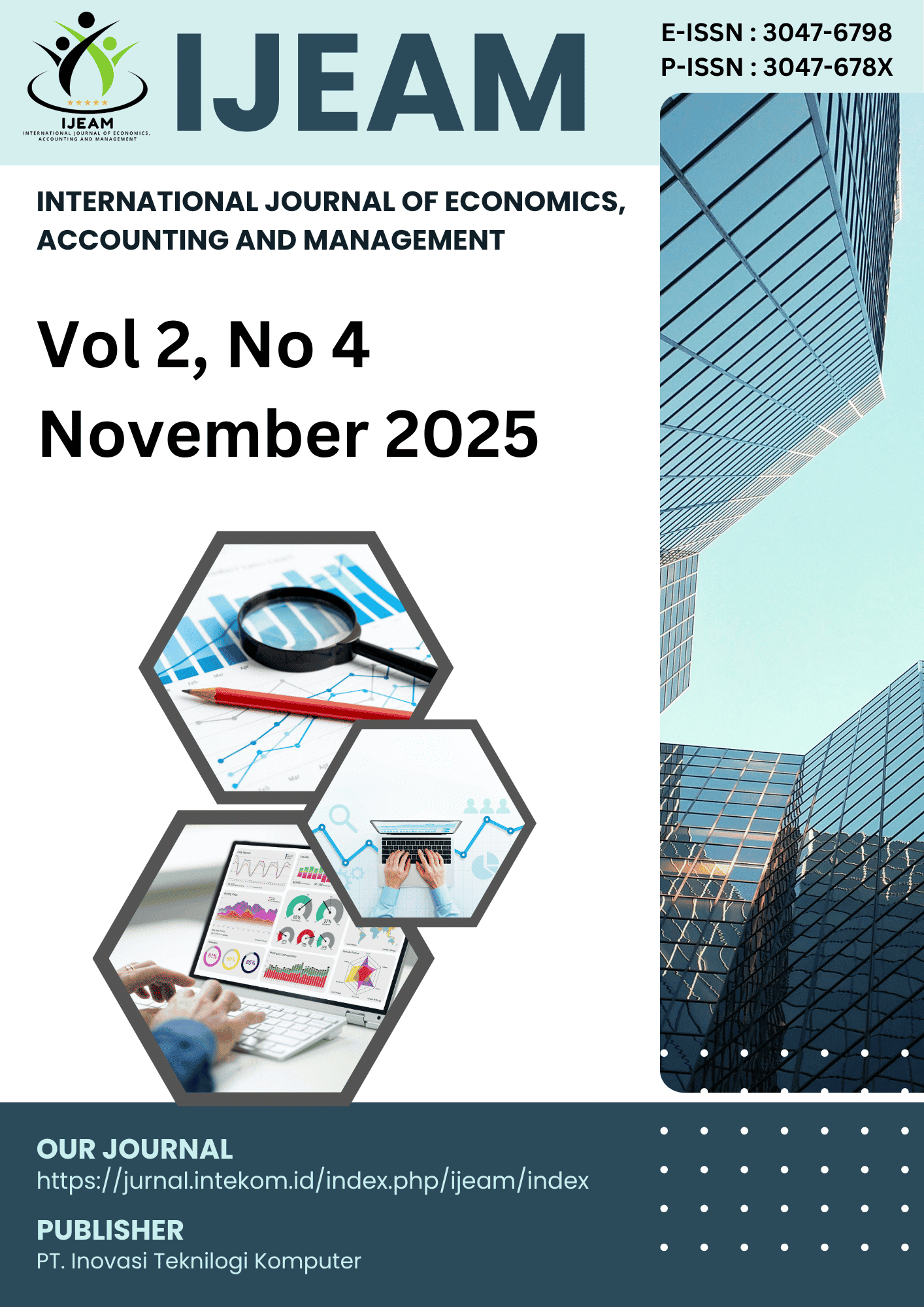
The Impact of Workplace Inclusion and Work-Life Balance on Workplace Happiness (Study at the Tanjungkarang Regional Office IV of PT Kereta Api Indonesia (Persero))
DOI:
https://doi.org/10.60076/ijeam.v2i4.1774Keywords:
Artificial Intelligence, Human-Centered AI, HR TransformationAbstract
The paradigm of human resource management (HR) has been significantly changed by the introduction of artificial intelligence (AI) after 2024. The HR function no longer focuses on administrative work, but becomes a strategic partner that uses technology to help make decisions, talent management, and improve employee experience. This study aims to analyze the transformation of HR strategies after 2024, identifying the key competencies that HR needs. The research method uses a Systematic Literature Review (SLR) of ten scientific articles published between 2024 and 2026. These articles were obtained via academic databases like Scopus, Google Scholar, ScienceDirect, and Emerald Insight. The results show that AI improves efficiency and analytical capabilities in HR functions, but its success depends on digital skills, ethical technology, and employee mental readiness. To ensure equitable and humane AI adoption, employees must learn a hybrid of skills, such as data analytics, interpersonal skills, ethical leadership, and change management skills.
References
E. Sukma Dewi and D. S. Anggraeni, “Hubungan antara Work Life Balance dengan Kebahagiaan di Tempat Kerja Pada Karyawan di PT. X,” Jurnal Pendidikan Tambusai, vol. 9, no. 1, pp. 8959–8965, 2025, doi: 10.31004/jptam.v9i1.26011.
M. Said and L. N. Adinna, “Pengaruh Work Life Balance Terhadap Retensi Karyawan, Kepuasan Kerja Sebagai Variabel Mediasi,” Jurnal Visionida, vol. 11, no. 1, pp. 78–86, 2025, doi: 10.30997/jvs.v11i1.19764.
O. Saputra and A. S. Dwianto, “Pengaruh Work Life Balance Terhadap Psychological Well Being pada Karyawan Pasca Pandemi COVID 19,” ED Journal, vol. 13, no. 2, pp. 306–311, 2025, doi: 10.37081/ed.v13i2.7023.
F. Yusuf, A. Husen, Suparno, and A. D. Suhendra, “The Determinant Analysis of Happiness at Work (HAW): A Systematic Literature Review,” Ilomata International Journal of Social Science, vol. 6, no. 2, pp. 371–391, 2025, doi: 10.61194/ijss.v6i2.1702.
F. Leuhery, N. Salu Padang, Karyono, D. Puspitasari, and L. Judijanto, “Workplace Diversity and Inclusion: Strategies for Effective Implementation and Benefits to Organizational Culture,” Dinasti International Journal of Economics, Finance & Accounting, vol. 5, no. 4, pp. 4647–4653, 2024, doi: 10.38035/dijefa.v5i4.3373.
A. Océvano Khosasi and R. G. Munthe, “Pengaruh Work Life Balance terhadap Kepuasan Kerja Karyawan: Studi Empiris pada PT X,” AGILITY: Lentera Manajemen SDM, vol. 3, no. 03, 2025, doi: 10.59422/lmsdm.v3i03.916.
J. Rizqiyah, “Pengaruh Keseimbangan Kehidupan Kerja (Work Life Balance) sebagai Faktor yang Mempengaruhi Kinerja Karyawan,” AGILITY: Lentera Manajemen SDM, vol. 2, no. 01, 2024, doi: 10.59422/lmsdm.v2i01.277.
S. Ikhlas and Y. Parwati, “Pengaruh Work Life Balance Terhadap Employee Retention with Job Satisfaction as Mediator,” Jurnal Kewirausahaan dan Inovasi, vol. 3, no. 2, 2024, doi: 10.21776/jki.2024.03.2.14.
“Workplace Inclusion Initiatives Across the Globe,” Societies, vol. 14, no. 11, 2024, doi: 10.3390/soc140110231.
Investigating the Effect of Inclusive Leadership on Employee Well Being, Scientific Reports, vol. 15, 2025, doi: 10.1038/s41598-025-23703-7.
Exploring Employee Happiness in High Performance Work Systems, International Journal of Organizational Analysis, 2025, doi: 10.1108/IJOA-01-2025-5134.
N. A. Oktavianisa and A. N. Halida, “Hubungan antara Work Life Balance dengan Job Hopping pada Karyawan Generasi Z,” Character Jurnal Penelitian Psikologi, vol. 12, no. 01, 2025, doi: 10.26740/cjpp.v12n01.p335-346.
A Systematic Literature Review on Employee Well Being: Mapping Organizational Factors, Journal of Vocational Behavior, 2025, doi: 10.1016/j.jvb.2025.3932.
T. Suparyanto et al., “Diversity and Inclusion in the Workplace: Effects on Employee Performance & Innovation,” RIGGS, vol. 4, no. 1, pp. 38–42, 2025, doi: 10.31004/riggs.v4i1.370.
Work–Life Balance, Organizational Support and Employee Outcomes: A Meta Analysis, Journal of Business Research, 2025, doi: 10.1016/j.jbusres.2025.112406.
Downloads
Published
How to Cite
Issue
Section
License
Copyright (c) 2025 Tribuana Ningrum, Ribhan

This work is licensed under a Creative Commons Attribution 4.0 International License.